Instructions for thesis
The thesis is a compulsory part of your studies and an achievement that requires you to utilise the knowledge and skills you have acquired during your studies, as well as the guidance you receive from your supervisor throughout the process. Depending on the degree programme, the thesis process includes instruction, supervision, and independent work. The content-related requirements are defined in more detail in each programme.
This page provides a brief overview of the stages of the thesis process and the progression of the work, as well as more detailed guidance on the thesis. If you are unsure or cannot find the information you are looking for, please contact the thesis supervisor of your degree programme.
On this page:
- Stages of the thesis
- Thesis guidelines
- Contact information
- 1
Planning
Topic and approach
- Consider what interests you and what you would like to explore more deeply in your thesis.
- A thesis may be research-based or practice-oriented, and it can take the form of, for example, a portfolio, diary, or work of art. Familiarise yourself with the different options and consider which approach suits both you and your topic.
- A thesis can be completed individually, as a pair or group project, if appropriate. Multidisciplinary theses and theses carried out in cooperation with different universities of applied sciences are also possible.
Topic approval, supervision, and the thesis plan
- Your topic must be approved before you can begin working on your thesis.
- Once the topic has been approved, a supervisor will be appointed for your thesis.
- The thesis plan defines, among other things, the literature-based background (theoretical framework), the aim and purpose of the thesis, as well as the implementation plan and schedule.
Information retrieval and knowledge base
- Allocate sufficient time for acquiring information and source literature and for familiarizing yourself with them.
- 2
Implementation
Conducting a development project or research
- During the implementation phase, you work on your thesis in accordance with the approved thesis plan and with the support of supervision, progressing toward your goal.
- Depending on the type of thesis, this phase may include activities such as data collection, analysis and interpretation, and the implementation of a development project or product.
Writing thesis report
- A written report is always required for a thesis. Use TAMK’s thesis template and the written reporting guidelines.
- Set aside time to finalise the thesis report, paying attention to language, referencing, and the overall layout.
- 3
Assessment and publication
Submitting the thesis
- Agree with your supervisor when the thesis is ready to be submitted for assessment.
- A plagiarism check is part of the process.
Maturity test
- The thesis includes a maturity test, through which you demonstrate your familiarity with the field of your thesis and confirm that you have achieved the required level of language proficiency.
Publication and assessment
- The thesis is published in the Theseus online library and archived. You are responsible for uploading it yourself.
- Familiarise yourself with the written publication instructions and follow them carefully—this will help you avoid delays.
- You will receive a written assessment of your thesis. It is advisable to review the assessment criteria at the very beginning of the thesis process so that they are clear to you from the outset.
Introduction
The thesis is a compulsory part of your studies. In the thesis process, you learn the foundations of research-based development work and demonstrate your competence in a format that fits your chosen approach. By working systematically and participating actively in thesis supervision, you ensure a successful outcome. Your thesis supervisor supports you throughout the process according to the agreed schedule.
Theses at universities of applied sciences are based on the needs of working life. You obtain your topic from an external commissioner, such as a company or an organization in the public sector; it may also be connected to a TAMK project, or you may propose your own topic. A good thesis topic is one that interests you personally, arises from practical needs, and is connected to your field and its development prospects.
The aims of the thesis are that, as a student, you develop your ability to work independently, search for information, critically analyse knowledge, solve problems, reason and argue effectively, investigate and develop work practices, and communicate clearly both in writing and orally.
Thesis Process
The thesis process is supervised and managed in the Wihi system. All communication related to the progress, supervision, and content of your thesis takes place and is documented in Wihi. All documents related to the thesis process must also be stored in Wihi.
The main stages of the thesis are planning, implementation as well as assessment and publication. The content of these stages is described in this guide. Any additional instructions specific to your degree programme or faculty are provided separately.
The picture 1 illustrates the thesis process. The process begins when the student enters a topic proposal into Wihi. The thesis coordinator for the degree programme then assigns a supervisor with whom you prepare a schedule and agree on regular supervision meetings. As your thesis progresses in Wihi from planning to implementation and finally evaluation and publication, your supervisor records 5 ECTS credits for each completed stage.
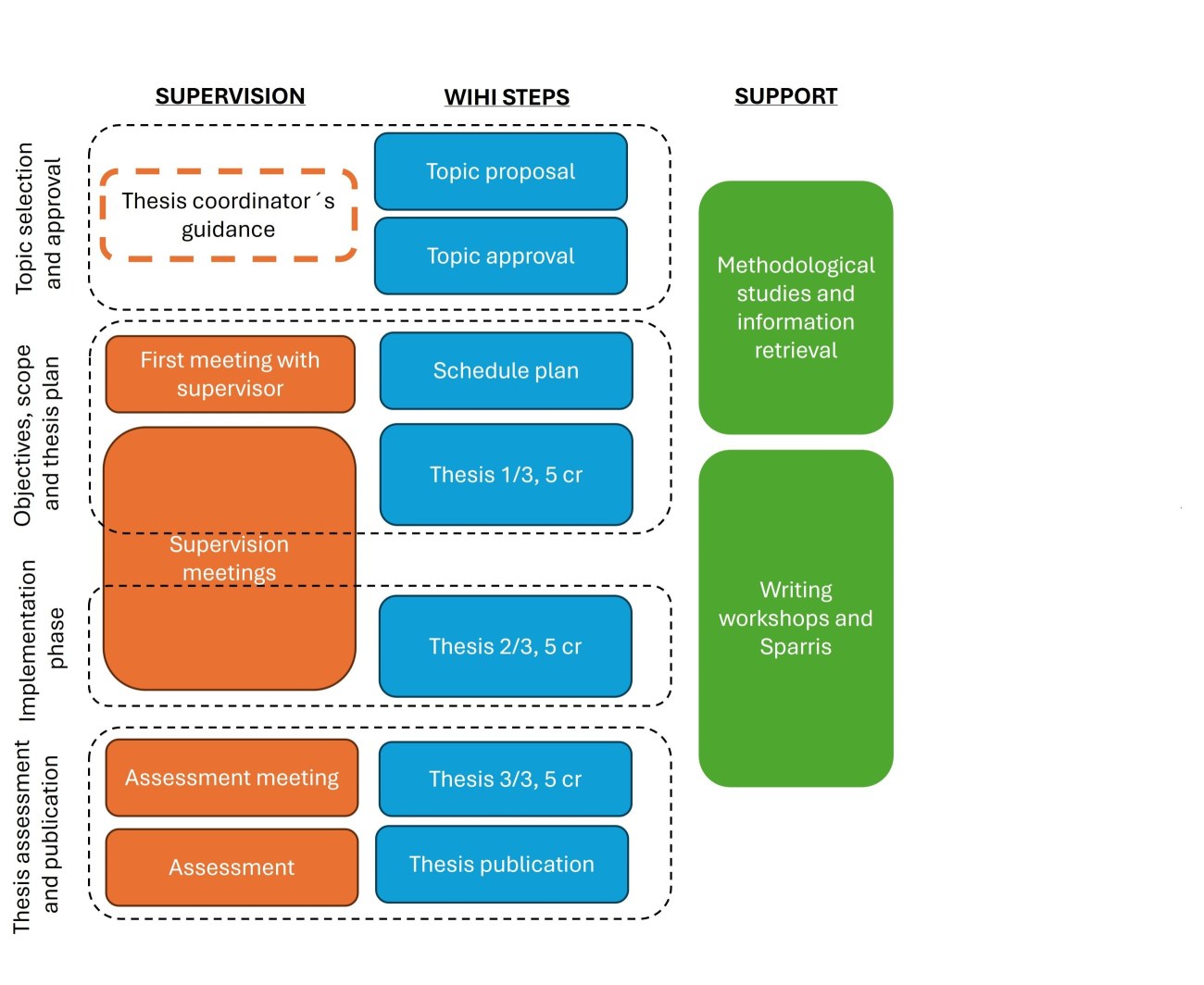
Picture 1. Thesis process.
Depending on your degree programme, the thesis process may include mandatory methodological studies or orientation courses. If needed, you can also take additional method courses as elective studies or, in master’s degree programmes, as optional advanced studies. You can improve and deepen your information‑seeking skills by attending workshops offered by the library. Ensuring sufficient methodological competence is part of thesis supervision.
You must actively use the various support services available at different stages of the thesis process. During supervision meetings, you and your supervisor discuss which support services you personally need. These may include writing workshops or study skill support provided by Sparris workshops.
For theses completed in cooperation with other higher education institutions or being done as part of a double degree, TAMK’s thesis guidelines are followed.
Wihi student guide
Sparris study skills workshops
Information searching studies
Research Methods Guidebook - Finnish Social Science Data Archive (FSD)
Planning
Theses may take various forms of investigation, planning, and development tasks that respond to the practical needs of working life and society. It is characteristic of all thesis types that the student familiarises themselves thoroughly with previous research, literature, and other relevant materials.
A thesis may be completed in the form of a research, practice-based, portfolio, diary-based or artwork thesis as table 1 indicates. The forms may vary and be emphasised depending on the degree programme, and it is advisable to discuss personal interests with the supervisor before choosing the final format. In master’s degree programmes, a research-oriented approach is emphasised.
Table 1. Types of thesis.
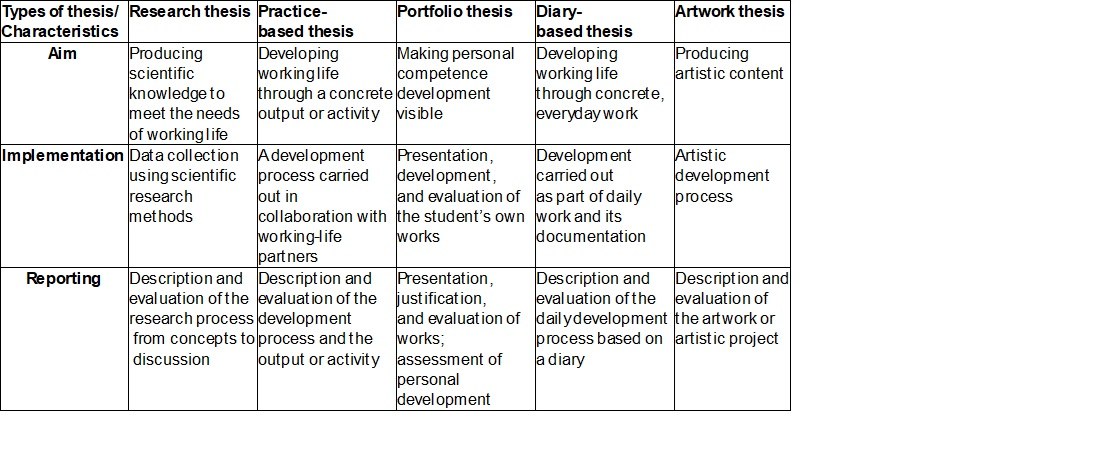
In a research thesis, you answer a research question or investigative task by producing knowledge using scientific methods. The thesis may be qualitative (e.g., analysis of interviews), quantitative (e.g., analysis of an electronic survey), or a systematic literature review based on structured information retrieval. The collected material is analysed, and the results are reported in the thesis report.
In a practice-based thesis, the starting point is a concrete task emerging from working life, which is addressed by developing practices within a target organisation. The outcome of the development process may be a product, service, guideline, plan, event, game, code, or model. In addition to the output, the thesis report documents and evaluates the development process.
A portfolio thesis is a work sample collection that describes the student’s own learning and development based on selected project works or other outputs, which are further developed or deepened. As part of the thesis, you create assessment criteria for the outputs you present and evaluate both them and your own professional development. In addition to text, the electronic portfolio may include images, videos, and podcasts. The thesis includes a report that contextualises, explains, and evaluates the portfolio process.
A diary-based thesis is a structured and scheduled way to complete a thesis by developing your own work or workplace practices. In the diary, you describe daily activities related to development and cooperation with stakeholders. Weekly, you analyse these activities and reflect on them in relation to theory. The thesis report consists of the aims and purpose, description of the diary method, summary of results, and reflection.
An artwork thesis is possible in cultural fields. It consists of an artistic or production technical project and a thesis report. The project may be, for example, a composition, concert, film, production, stage work, script, work of art, exhibition, or performance. The written report provides background, deepens, and reflects on the project component.
All thesis formats require a written report following TAMK’s reporting guidelines. The specific characteristics of each type appear in the content of the report, but all reports must demonstrate the theoretical framework for the topic, description of the implementation process as well as an evaluative perspective on the overall work.
Selecting a topic and ensuring its relevance for both you and working life is a central part of the process. The topic is finally approved by the thesis coordinator.
A supervisor is always appointed for the thesis. The supervisor supports the student throughout the thesis process. Supervision is particularly important in the early stages, when discussing the thoughts, feelings, and meanings the thesis evokes for the student, as well as content related issues.
Supervision consists of supervision discussions and textual feedback. Between meetings, the student must actively work on the thesis and proceed according to the agreed schedule. As a student, you are responsible for the overall process and for keeping in contact with the supervisor and any client organisation.
In theses completed for a working-life partner, the commissioner appoints a contact person as their representative. The representative of the company, organisation, or community participates together with you and your supervisor in defining the objectives of the thesis and planning its implementation.
The contact person is responsible for the cooperation opportunities related to carrying out the thesis and, where possible, provides contentrelated supervision as well as the information needed for completing the thesis. The representative of the cooperating organisation may also provide you with a written evaluation on the thesis.
A thesis plan is prepared for every thesis, and it helps to limit the scope and describes concretely how the thesis will be carried out. The plan specifies, among other things, the thesis topic, the phenomenon background based on literature and previous research, the purpose and aim, as well as the implementation plan with a schedule. The thesis plan is an essential document, because it is attached as an appendix to the thesis contract or permit.
A thesis contract or permit is prepared for every thesis and is archived in the Wihi system. The thesis contract or permit is drawn up between the you, the educational institution, and the working‑life partner, and through it the parties commit to the process and roles defined in the thesis plan. All parties’ signatures are requested on the contract by using mainly AtomiSign. The need for a thesis contract or research permission, the forms used, and the practices must be clarified individually for each thesis process.
Data Protection and Copyright
Regarding the materials collected for theses, it is essential that you know and understand the key requirements and practices related to data protection. The data protection practices and policies of our higher education community are based on the Data Protection Act (1050/2018) and the EU General Data Protection Regulation (2016/679; GDPR). When theses exceptionally involve the processing of personal data (personal data), members of the higher education community must comply with the EU General Data Protection Regulation and the Data Protection Act.
In the context of the thesis process, copyright issues are relevant
when using existing material (source material) and assessing the conditions for its use, and
when evaluating the rights that arise for the thesis author(s) themselves and the possible need to transfer those rights.
In addition to the above factors, the use of material may also be restricted by regulations concerning privacy protection, trade or professional secrets, trademark protection, contractual limitations, or actions that violate good scientific practice.
The thesis supervisor is bound by confidentiality and the prohibition of using the information and materials for their own benefit throughout the thesis process and after it.
The copyright of the thesis primarily belongs to the student when a commissioner is involved. However, the commissioner is allowed to use the information and development proposals included in the thesis regardless of copyright. If the thesis report contains content or outputs that the commissioner wishes to use in a manner that is legally significant with respect to copyright, the transfer of rights must be agreed upon separately in writing.
Instructions for students concerning data protection
Instructions for supervisors concerning data protection
Data protection in research
Ethics
Universities of Applied Sciences are committed to complying with and applying the ethical guidelines of the Finnish National Board on Research Integrity (TENK) in theses. Compliance with good scientific practice is a prerequisite for the ethical acceptability, reliability, and credibility of the results of a thesis. As the author of the thesis, you are personally responsible for following these guidelines in your own work.
The ethical thesis guidelines issued by the Rectors’ Conference of Finnish Universities of Applied Sciences (ARENE) form another key set of instructions that you are responsible for familiarising yourself with and adhering to.
In addition, there may be field specific ethical guidelines (especially in the social and health care sectors), which are reviewed within the relevant degree programme during the thesis process.
Being caught plagiarising in a thesis may lead to the rejection of the entire thesis.
In the thesis process, you are required to use AI applications responsibly and ethically. The use of AI must always be mentioned and described in the thesis report, including how it has been used in different stages and sections of the thesis. Instructions for reporting the use of AI in a thesis can be found in TAMK’s report guide.
Research Integrity
Ethical Recommendations for Theses in Universities of Applied Sciences (webpage in Finnish, publication also in English).
AI in studies
Implementation
Implementation Phase of the Thesis
In the implementation phase, you carry out the empirical, theoretical, and/or functional part of the thesis according to the thesis plan and participate actively in regular supervision meetings. You are responsible for ensuring that the thesis process stays on schedule. Any necessary content‑related clarifications and changes are discussed during supervision meetings.
Written Report
A written report is prepared for all theses at TAMK. In degree programmes taught in Finnish, the thesis may be written in other language when this is appropriate for the topic and when a supervisor proficient in that language is available within the degree programme. In degree programmes taught in a foreign language, the thesis is written in the language of instruction (see the degree regulations). The report contains the essential elements related to the selection of the topic, the theoretical foundations, the method or mode of implementation, the results, and the conclusions. The content emphasis of the report may vary depending on the degree programme.
The thesis report is prepared at TAMK in a uniform manner. The language of the report must be clear and consistent with good academic writing style. Instructions related to writing have been compiled in the TAMK’S report guide. The thesis report must be prepared using TAMK thesis report template found in the report guide.
An electronic text originality checking system (Turnitin) is used for all theses. You may use the Turnitin practice environment to support your own learning and supervision during the process. The originality check of the completed thesis text is carried out through Wihi.
At TAMK, presenting the thesis is not required for new bachelor’s theses starting from 1st January 2026. Theses started earlier as well as master´s theses follow the degree programme specific instructions. The thesis may be presented in a manner agreed separately with the commissioner.
Report Guide
Turnitin - Assessing originality of thesis | TAMK
Assessment and Publication
You and your thesis supervisor agree on when the thesis is ready for the final evaluation. Once the thesis is completed, it is submitted to the supervisor and the commissioner for review in accordance with the degree programme specific instructions.
You have the right to receive feedback on your completed thesis and to see how the work has been assessed. The supervisor provides a written evaluation of your thesis within the time specified in the degree regulations. The representative may also provide you with a written statement on the thesis.
When all partial components of the thesis have been approved, the thesis is evaluated on a scale of 1–5 using TAMK’s common evaluation criteria and evaluation form. It is advisable for you to familiarise yourself with the evaluation criteria in advance so that they are known to you from the beginning of the thesis process.
Each thesis format has its own evaluation criteria:
A minimum grade of 1 must be achieved in all assessed areas for the thesis to be approved. When two authors are involved, the individual contributions of each author must be clearly identifiable if different grades are to be awarded.
If dissatisfied with the grade, the student may request a rectification as stipulated in the degree regulations.
As a student, you write a maturity test related to your thesis. The maturity test has two main purposes: through it, the student demonstrates familiarity with the field of their thesis, and a passed maturity test serves as proof of proficiency in the Finnish or Swedish language as required by the Language Proficiency Act. As of 1 January 2026, in bachelor’s degree programmes, the thesis abstract serves as the maturity test and is approved by the thesis supervisor.
The supervisor may require the maturity test to be written under supervision if, for a justified reason, they consider that the competence required for the two main purposes mentioned above would not otherwise be demonstrated clearly enough.
In a bachelor’s degree, the abstract serves as the maturity test, with the exceptions mentioned above. If the thesis is completed as a pair or group work, each student writes their own abstract. The students choose which abstract will be published as part of the thesis report. The abstract is submitted to the supervisor in Wihi for inspection.
The text of the abstract must not be produced using artificial intelligence (a language model).
As a bachelor’s student, you write the maturity test in the language (Finnish or Swedish) in which you completed the degree that served as the educational prerequisite for your degree programme. If you received your school education in a language other than Finnish or Swedish, or you completed your schooling abroad, you may choose Finnish or English as the language of the maturity test. More detailed information on determining the language of the maturity test can be found in the degree regulations (§23).
If your school education language is Finnish and you write the thesis in other language, you must also submit a separate abstract written in Finnish to your supervisor. If your school education language is Swedish, you complete a separate supervised maturity examination in Swedish or submit a separate Swedish language abstract to the language teacher.
Master’s degree students do not write a maturity test if they already hold a previous bachelor´s degree in the same field as the degree they are completing.
When the abstract serves as the maturity test, the supervisor reviews the content and language of the maturity test. The maturity test is assessed on a pass/fail basis.
Abstract as Maturity Test
Separate Maturity Test (when abstract is not used as maturity test)
A thesis is a public document, and any confidential information must not be included in it. Publicity ensures the objective and equal evaluation of theses. If the thesis contains partially confidential information, such information must not be included in the thesis report that serves as the basis for evaluation. If your thesis includes classified information, it may not be included into the thesis report to be assessed. You can find separate instructions for classified information in theses.
The thesis is stored in Theseus, the online repository for theses completed in Universities of Applied Sciences. As a rule, you upload your thesis to the open Theseus publication archive. Before publishing your thesis, you must carefully familiarise yourself with the library’s instructions. By following the instructions, you will streamline the publication process and your own graduation. Carelessness, such as errors in the title, formatting of the cover page, or submitting the thesis in an incorrect format, delays the process.
The thesis must always be saved in Theseus in PDF/A format.
You upload your own thesis to Theseus. If the thesis has multiple authors, one of the authors uploads it on behalf of the others. If the authors represent different Universities of Applied Sciences, each author uploads the thesis to their own institution’s collection. In TAMK’s collection, the thesis must be uploaded with the TAMK thesis cover page.
Before the final approval of the thesis and the issuance of the degree certificate, the thesis must be published and stored in Theseus for archiving.
Students hold full copyright to all parts of the thesis that are stored. Uploading and publishing the thesis in the Theseus online repository requires that the thesis has been approved and that you grant permission for its publication.
If, for example, the commissioner prohibits publishing the thesis online, it may be added to the restricted-access collection in Theseus. Theses in the restricted collection can be read only on designated computers in the library premises. Note that the library is obliged to provide a thesis stored in the restricted-access collection to an applicant upon an official information request.
More information on submitting the thesis to the library can be found in the Library's guide.
If you wish, you may create a printed and bound version of your thesis for your own use. You can purchase covers from Campusravita café and bind the thesis using the machine located in the library lobby, using a single-sided printout of your thesis. Note that the library does not acceptprinted theses.
Theses are documents that, by decision of the National Archives of Finland (16 September 2014), must be preserved permanently. According to this decision, Universities of Applied Sciences are responsible for ensuring that theses are stored in accordance with good information management practices and that their usability is guaranteed also in the future.
The archiving of the thesis is carried out in connection with the publication of the thesis. For a thesis saved in Theseus, you don´t need to submit a separate archival copy.